
达尼埃尔·于伊
搜索"达尼埃尔·于伊" ,找到 4部影视作品
导演:
/
达尼埃尔·于伊耶,让-马里·斯特劳布
主演:
/
内详
剧情:
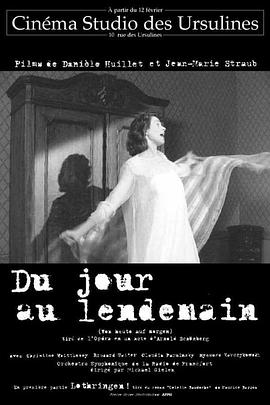
Based on an unknown Schönberg opera from 1929, From Today Until Tomorrow explores one night in a not-quite loveless marriage. A husband and wife return from a party where she has flirted with another man, while he has cast an appraising eye toward an attractive, fashionably dressed acquaintance of his wife’s. Though each dreams, briefly, of leaving the marriage for the excitement and mystery of a new lover, in the end they decide stability and comfort are more important than the fleeting thrill of new romance. Directors Jean-Marie Straub and Danièle Huillet, who previously collaborated on two other films about music (The Chronicle of Anna Magdalena Bach, 1968, and Moses and Aaron, 1975), rely on long fixed shots in austere black-and-white so that the focus remains on the musical brilliance of Schönberg’s atonal score, performed here by 70 musicians. That Schönberg would choose such a relatively lighthearted message for his newly discovered musical language remains a mystery, especially since the conclusion reached by the husband and wife—to stick with the tried and true—seems directly at odds with Schönberg’s own philosophy of composing. It is just this juxtaposition, however, coupled with Straub and Huillet’s faithful presentation, that makes the opera a compelling addition to the Schönberg canon—and the film such a challenging and intriguing experience.
导演:
/
让-马里·斯特劳布
主演:
剧情:
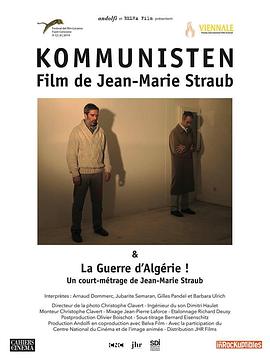
81-year-old master, Jean-Marie Straub, once again invents and surprises with his latest film. Kommunisten consists of six parts, five of which have been taken from his earlier works. Straub does not aim to be self-reverential, but instead wants to make different blocks (of text, time, and languages) clash so as to highlight invisible elements of feelings and politics. It is a film about human adventure, from the past century to the one ahead. In this project, all the things that the films of Jean-Marie Straub and Danièle Huillet have been based on for the past fifty years, find their most raw and recent form.
导演:
/
达尼埃尔·于伊耶,让-马里·斯特劳布
主演:
剧情:
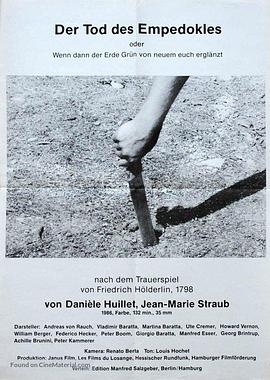
The subject of Danièle Huillet and Jean-Marie Straub’s Der Tod des Empedokles (The Death of Empedocles, 1987) is the Greek pre-Socratic philosopher Empedocles (c. 490 BC – 430 BC), who lived in the Greek colony of Agrigentum in Sicily. His theories are mentioned in several of Plato’s dialogues. He maintained that all matter is made up of four irreducible elements: water, earth, air and fire. A mystic and a poet, he is considered to be the founder of classical rhetoric. He is also thought to be the last Greek philosopher to write in verse two fragments of his works survive: Katharmoi (Purifications) and Peri Phuseôs (On Nature). An advocate of democracy, he came into conflict with his fellow citizens of Agrigentum and, as result, was banished with his young disciple, Pausanius. When he was asked to return, he preferred to commit suicide by throwing himself into the active volcano at Mount Aetna. The German writer Friedrich Hölderlin wrote two versions of Der Tod des Empedokles in 1798 and 1800, and a final third version in 1820, all three ultimately unfinished. They were conceived as five-act tragedies and all three differ in plot. According to Michael Hamburger, Hölderlin’s English-language translator, the main reason why Hölderlin finished no version of the play must be that he remained too closely identified with Empedocles, at the very period in his life when his own view of the poet as philosopher, prophet and priest – and as tragic hero – was subject to perpetual crisis and re-examination. Huillet-Straub’s The Death of Empedocles is based on Hölderlin’s first version (the longest of the three), whereas Black Sin is based on the third version.
导演:
/
达尼埃尔·于伊耶,让-马里·斯特劳布
主演:
/
内详
剧情:
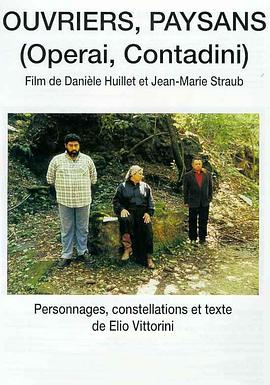
"Veteran experimental filmmakers Danielle Huillet and Jean-Marie Straub helmed this unusual adaptation of a novel by Elio Vittorini. Focused on the triumphs and failures of a group of laborers and farm hands who pooled their resources to operate an alternative collective farm after the end of World War II, Operai, Contadini features a cast of 12 actors who read aloud from Vittorini's book for the duration of the film, either reciting from memory or using a clearly visible script. Hardly designed to be a crowd pleaser, Operai, Contadini proved to be controversial among the audiences for its showings at the 2001 Cannes Film Festival, where it was screened as part of the Directors' Fortnight series." ~ Mark Deming, All Movie Guide "The group makes up a primitive community which seeks to erase not only the distress created by the war but also the hardships of life and hunger, and to protect them from violence, misery and fear. Amid the ruins of this post-war period, the characters build and invent a rapport both in their professional and daily lives between themselves, the sexes, generations, diverse social and geographical origins, and antagonistic political camps. The group maintains a 'register', a kind of diary, as if it were entering the minutes of an inquiry or a trial." -Steve Grayson "my favorite Straub-Huillet films are Too Early, Too Late and Operai, contadini (2001), both color landscape films with especially acute senses of place as well as of nature in all its harsh beauty." - Jonathan Rosenbaum